
What is the most important measurement when replacing a kitchen faucet? The most critical measurement is the hole spread on your sink or countertop, as this dictates the type of faucet you can install. If you need to measure your current kitchen faucet for replacement or to ensure a new one fits, this guide will walk you through all the essential kitchen faucet dimensions. We’ll cover faucet height, spout reach, faucet base width, and more, helping you make the right choice.
Choosing a new kitchen faucet can be exciting, but it can also be a bit confusing if you’re not sure what to look for. One of the biggest hurdles many people face is ensuring the new faucet will fit their existing sink or countertop. This is where knowing how to measure your current faucet and the space it occupies becomes crucial. This detailed guide will break down every measurement you need to take, making your faucet shopping experience smooth and successful.
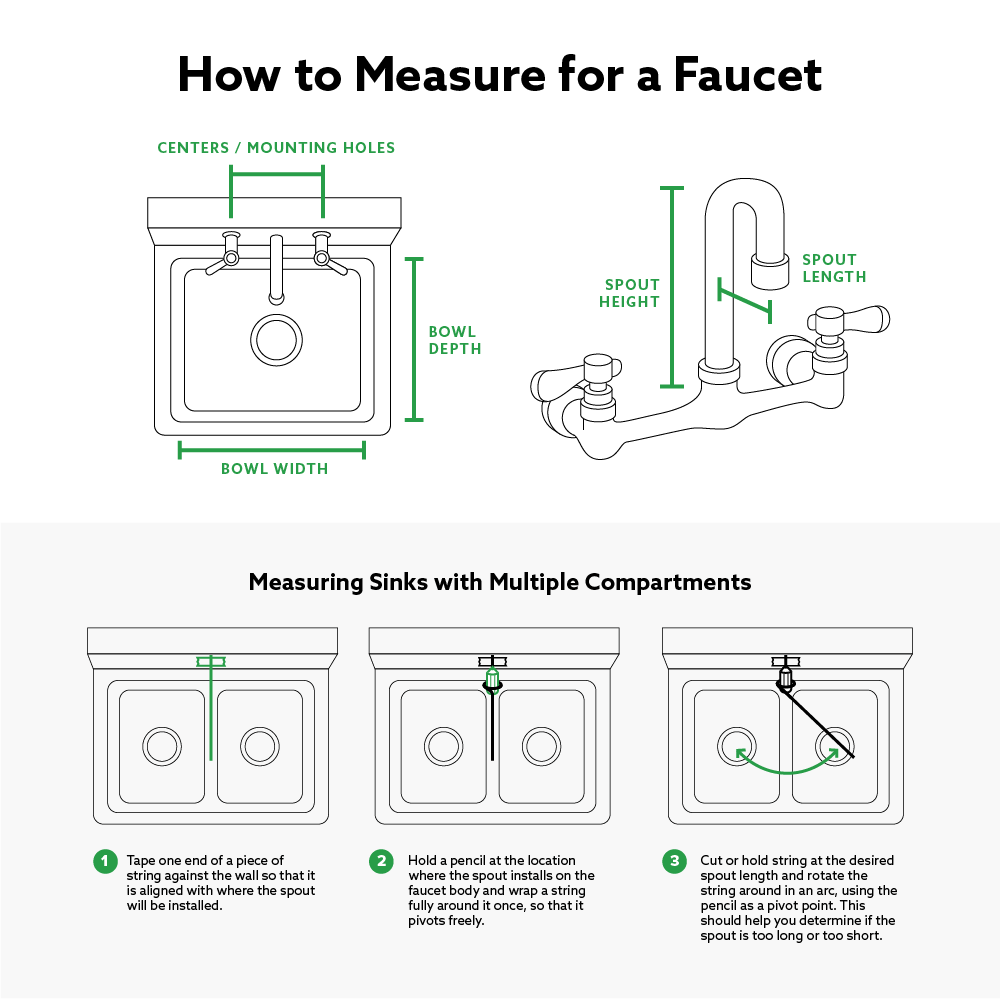
Image Source: lirp.cdn-website.com
Why Measuring Your Kitchen Faucet Matters
Before we dive into the specifics of measurement, let’s quickly touch on why this is so important.
- Compatibility: The most common reason to measure is to ensure a new faucet will fit the holes already present in your sink or countertop. Mismatched measurements can lead to costly mistakes or the need for additional drilling, which might not always be feasible.
- Functionality: Correct measurements ensure the faucet operates without obstruction. For instance, knowing the faucet height is vital to make sure it won’t hit overhead cabinets or shelves. The spout reach determines if the water stream will land conveniently in your sink basin.
- Aesthetics: While less critical than compatibility, proper measurements contribute to the overall look of your kitchen. A faucet that is too large or too small for the space can look out of place.
Essential Kitchen Faucet Measurements
Let’s get down to the nitty-gritty of measuring. Grab a tape measure, a notepad, and maybe a helping hand!
1. Hole Spread: The Most Critical Measurement
This is the most crucial measurement because it directly determines the type of faucet you can install.
What is Hole Spread?
The hole spread refers to the distance between the center of the faucet holes on your sink or countertop. Kitchen faucets are designed to fit specific hole configurations.
Common Hole Spreads:
- Single-Hole Faucet: Requires only one hole. These often have a base plate or escutcheon to cover any additional pre-drilled holes.
- Four-Inch Centerset: The faucet and handles are typically mounted on a single unit with a 4-inch spread between the handles.
- Eight-Inch Widespread: The faucet, handles, and sometimes the soap dispenser are separate components, with an 8-inch spread between the hot and cold water handles.
- Commercial-Style Faucets: These often have unique configurations and may require specific measurements.
How to Measure Hole Spread:
- Locate the Holes: Identify the holes in your sink or countertop that the current faucet occupies.
- Measure Center to Center: Using your tape measure, measure the distance from the center of one hole to the center of the next hole that the faucet assembly uses.
- For a single-hole faucet, this measurement isn’t applicable to the sink itself but rather to the faucet’s base.
- For a 4-inch centerset, measure from the center of the hole for the spout/handle assembly to the center of the hole for the handle assembly.
- For an 8-inch widespread, measure from the center of the hole for one handle to the center of the hole for the other handle.
Table: Common Faucet Hole Configurations
| Faucet Type | Number of Holes | Typical Hole Spread | Notes |
|---|---|---|---|
| Single-Handle | 1 | N/A | May require an additional hole for sprayer, soap dispenser, or a base plate. |
| Single-Handle w/ Sprayer | 2 | N/A | Faucet and sprayer are separate units. |
| Single-Handle w/ Base Plate | 3 | N/A | Base plate covers 3 holes (faucet + 2 unused). |
| Centerset | 3 | 4 inches | Faucet, spout, and handles are mounted on a single unit. |
| Widespread | 3-4 | 8 inches | Faucet, hot handle, and cold handle are separate pieces. |
2. Faucet Height Measurement
The faucet height measurement is important for ensuring clearance and usability.
What is Faucet Height?
Faucet height is the vertical distance from the countertop or sink deck to the highest point of the faucet.
Why Measure Faucet Height?
- Cabinet Clearance: If you have low-hanging cabinets or shelves above your sink, you need to ensure the new faucet’s height won’t interfere with them.
- Ease of Use: Taller faucets can make it easier to wash large pots and pans.
How to Measure Faucet Height:
- Measure from the Sink Deck: Place the base of your tape measure on the surface where the faucet is mounted (sink deck or countertop).
- Measure to the Highest Point: Extend the tape measure vertically to the absolute highest point of the faucet. This is usually the top of the spout or the highest curve of the faucet body.
3. Spout Reach
The spout reach determines how far the water will spray into your sink.
What is Spout Reach?
Spout reach is the horizontal distance from the center of the faucet body (or mounting base) to the tip of the spout.
Why Measure Spout Reach?
- Sink Coverage: You want the water stream to land in the middle of your sink basin, not too close to the back or too far out, which could cause splashing.
- Functionality: A longer spout reach is often preferred for double-basin sinks or deeper sinks to easily fill pots.
How to Measure Spout Reach:
- Identify the Center: Locate the center of the faucet’s base where it meets the sink or countertop.
- Measure to the Spout Tip: Extend your tape measure horizontally from the center point to the very tip of the spout where the water comes out.
4. Spout Height (or Clearance)
This is similar to faucet height but specifically relates to the spout.
What is Spout Height (or Clearance)?
Spout height is the vertical distance from the sink deck to the tip of the spout. This measurement is often referred to as spout overhang when discussing how far it extends over the sink.
Why Measure Spout Height?
- Washing Large Items: A higher spout provides more clearance for washing large pots, pans, and platters.
- Aesthetics and Ergonomics: It can also influence the overall look and ease of use.
How to Measure Spout Height:
- Measure from the Sink Deck: Place the base of your tape measure on the sink deck or countertop directly below the spout.
- Measure to the Spout Tip: Extend the tape measure vertically to the tip of the spout.
5. Faucet Base Width
The faucet base width is important if you have limited space around the faucet.
What is Faucet Base Width?
Faucet base width is the widest part of the faucet’s mounting base or escutcheon plate.
Why Measure Faucet Base Width?
- Clearance: If your sink has a raised edge, backsplash, or other features near the faucet holes, you need to ensure the new faucet’s base won’t collide with them.
- Aesthetics: It also impacts how much of the sink deck is covered by the faucet.
How to Measure Faucet Base Width:
- Measure the Widest Point: Measure the widest horizontal dimension of the faucet’s base or any decorative plate it sits on.
6. Faucet Handle Clearance
This measurement is vital for single-handle faucets or for ensuring enough space to operate any handles.
What is Faucet Handle Clearance?
Faucet handle clearance refers to the space needed for the faucet handle(s) to move freely without hitting any backsplash, walls, or other obstructions.
Why Measure Faucet Handle Clearance?
- Operation: If the handle hits a backsplash, you won’t be able to turn the faucet on or off properly.
- Ergonomics: Adequate clearance makes the faucet easier to use.
How to Measure Faucet Handle Clearance:
- Determine Handle Swing: Identify the arc the handle(s) will move through when turned on and off.
- Measure Obstruction Distance: Measure the distance from the edge of the faucet base to any backsplash or wall behind it.
- Compare: Ensure the space is greater than the arc the handle needs to swing. For single-handle faucets, a common measurement is the distance from the faucet center to the backsplash. A minimum of 2-3 inches is often recommended, but this can vary.
Measuring Components Within the Faucet
Beyond the external dimensions, understanding certain internal components can be helpful, especially if you’re dealing with repairs or specific types of faucets.
7. Cartridge Size
The cartridge size is key for faucet repairs.
What is Cartridge Size?
The cartridge is the internal mechanism that controls the flow and temperature of the water in most modern faucets. Different faucet brands and models use different types and sizes of cartridges.
Why is Cartridge Size Important?
- Repairs: If your faucet is leaking or has temperature control issues, you’ll likely need to replace the cartridge. Knowing the correct size and type is essential for buying the right replacement part.
- Universality: While some cartridges are proprietary to a brand, others are more universal.
How to Determine Cartridge Size:
- Identify Faucet Brand and Model: The easiest way is to look for the brand name (e.g., Moen, Delta, Kohler) and any model number or name.
- Consult Manuals: Check the faucet’s original installation or owner’s manual.
- Visual Inspection/Online Search: If you don’t have the manual, you might need to disassemble the handle to see the cartridge. Take pictures or note its shape and dimensions and search online using the brand and any visible markings. Websites of major faucet manufacturers often have detailed diagrams and parts lists.
- Measure: If you can remove the cartridge, you can measure its length, diameter, and the number of ports (holes) it has.
8. Faucet Adapter Size
Sometimes, you might need an adapter for connecting hoses or other accessories.
What is Faucet Adapter Size?
This refers to the threading or connection type used by the faucet for attaching things like spray hoses, water filters, or even certain types of aerators.
Why is Faucet Adapter Size Important?
- Connecting Accessories: If you’re adding a water filter or replacing a spray hose, you need to know the correct adapter size to ensure a leak-free connection.
- Standardization: Many plumbing connections follow standard sizes, but there can be variations.
How to Determine Faucet Adapter Size:
- Inspect Connections: Look at the threaded connections where hoses or accessories attach.
- Measure Threads: You might need to measure the diameter of the threaded portion and count the number of threads per inch (TPI).
- Consult Faucet Specifications: Check your faucet’s manual or the manufacturer’s website for specifications on connection types and sizes. Common connections include NPT (National Pipe Thread) or specific quick-connect fittings.
Measuring for Different Faucet Types
Let’s look at how measurements apply to common faucet styles.
Single-Handle Faucets
- Hole Spread: Most single-handle faucets are designed for a single hole, but some come with an optional base plate that can cover up to three holes (4-inch spread). Always check the faucet’s specifications for compatibility.
- Spout Reach and Height: Crucial for sink coverage and clearance.
- Handle Clearance: Ensure the handle can swing freely, especially if there’s a backsplash.
Centerset Faucets (4-Inch Spread)
- Hole Spread: This is the defining measurement for centerset faucets. You must have a 4-inch spread of holes on your sink.
- Base Width: The faucet, spout, and handles are on one unit, so the overall base width matters less than the hole spread.
Widespread Faucets (8-Inch Spread)
- Hole Spread: The standard is an 8-inch spread between the centers of the hot and cold water handle holes.
- Component Separation: Each piece (faucet, hot handle, cold handle) can be positioned within a range, allowing for some flexibility. However, the overall footprint and the distance between the handles are key. Measure the space between the handles to ensure it fits your sink’s pre-drilled holes.
- Spout Reach and Height: As with single-handle faucets, these are important for sink coverage and clearance.
Pull-Down and Pull-Out Faucets
- Hole Spread: Typically designed for single-hole installations, but many come with optional base plates for 3-hole sinks.
- Faucet Height: This is particularly important as the spray head can be pulled down or out, and you need to ensure the faucet body itself doesn’t hit anything.
- Spout Reach: Still critical for reaching all corners of the sink.
- Hose Length: While not a direct faucet measurement, consider the length of the pull-down/pull-out hose to ensure it reaches all parts of your sink and comfortably retracts. This is usually specified by the manufacturer.
Steps for Measuring Your Existing Faucet
Here’s a simple, step-by-step process:
-
Preparation:
- Turn off the water supply valves under the sink.
- Open the faucet to drain any residual water.
- Clear the area around the faucet for easy access.
- Gather your tools: tape measure, notepad, pen.
-
Measure Hole Spread:
- If you have a 3-hole setup, measure from the center of the faucet hole to the center of the handle hole (for centerset) or from the center of one handle hole to the center of the other (for widespread).
-
Measure Faucet Height:
- Measure from the sink deck to the highest point of the faucet.
-
Measure Spout Reach:
- Measure from the center of the faucet base to the tip of the spout.
-
Measure Spout Height (Clearance):
- Measure from the sink deck to the tip of the spout.
-
Measure Faucet Base Width:
- Measure the widest part of the faucet’s base.
-
Check Handle Clearance:
- Measure the distance from the faucet base to the backsplash.
-
Document Everything:
- Write down all your measurements clearly. Sketching a simple diagram can also be helpful.
Tips for Accurate Measurement
- Use a Flexible Tape Measure: This can be easier for measuring curves and tight spots.
- Get a Second Opinion: Having someone else help can reduce errors.
- Double-Check: Measure each dimension at least twice.
- Consider the Backsplash: If you have a backsplash, measure your faucet handle clearance carefully. Some faucets are designed to work with backsplashes, while others are not.
- New Faucet Specifications: When shopping for a new faucet, always compare its dimensions to your measurements and ensure it matches your sink’s hole spread. Look for the manufacturer’s specification sheet.
Frequently Asked Questions (FAQ)
Q1: What if my sink has more holes than my new faucet requires?
A1: This is common when upgrading from a 3-hole faucet (like a centerset) to a single-hole faucet. Most single-hole faucets come with an optional base plate or escutcheon that can cover the extra holes for a clean look. Ensure the base plate is included or purchase one separately that fits your new faucet.
Q2: Can I install a faucet with a different hole spread than my sink?
A2: It’s generally not recommended unless you are willing to drill new holes in your countertop or sink, which can be difficult and risky, especially with certain materials like granite or stainless steel. It’s best to match the hole spread of your sink.
Q3: How do I measure the distance for a 3-hole faucet on a sink that only has one hole?
A3: If your sink only has one hole, you can install a single-handle faucet designed for a single hole, or a faucet that comes with a base plate covering three holes. For widespread faucets (typically 8-inch spread), you would need a sink with at least three holes spaced appropriately, or you’d need to have them drilled.
Q4: What does “spout overhang” mean, and how is it measured?
A4: Spout overhang is another term for the spout reach. It refers to how far the spout extends horizontally from the faucet’s base and over the sink basin. It’s measured from the center of the faucet base to the tip of the spout.
Q5: Do I need to measure anything if I’m just replacing the cartridge?
A5: Yes, you’ll need to identify the cartridge size and type. This usually involves knowing the faucet’s brand and model number, or carefully removing and measuring the old cartridge.
By carefully taking these measurements, you can confidently select and install a new kitchen faucet that fits perfectly and functions beautifully in your space. Happy measuring!