
Can you replace a kitchen faucet without knowing its measurements? No, you can’t. You need to measure your existing faucet accurately to ensure the new one fits your sink and plumbing. This guide will help you measure your kitchen faucet correctly so you can buy a replacement with confidence.
Replacing a kitchen faucet is a common DIY project, but it can seem daunting if you’re unsure about what measurements to take. Getting the right measurements ensures your new faucet will be compatible with your sink and plumbing, saving you time, frustration, and potential return trips to the store. This detailed guide will walk you through each crucial measurement, helping you navigate the process with ease.
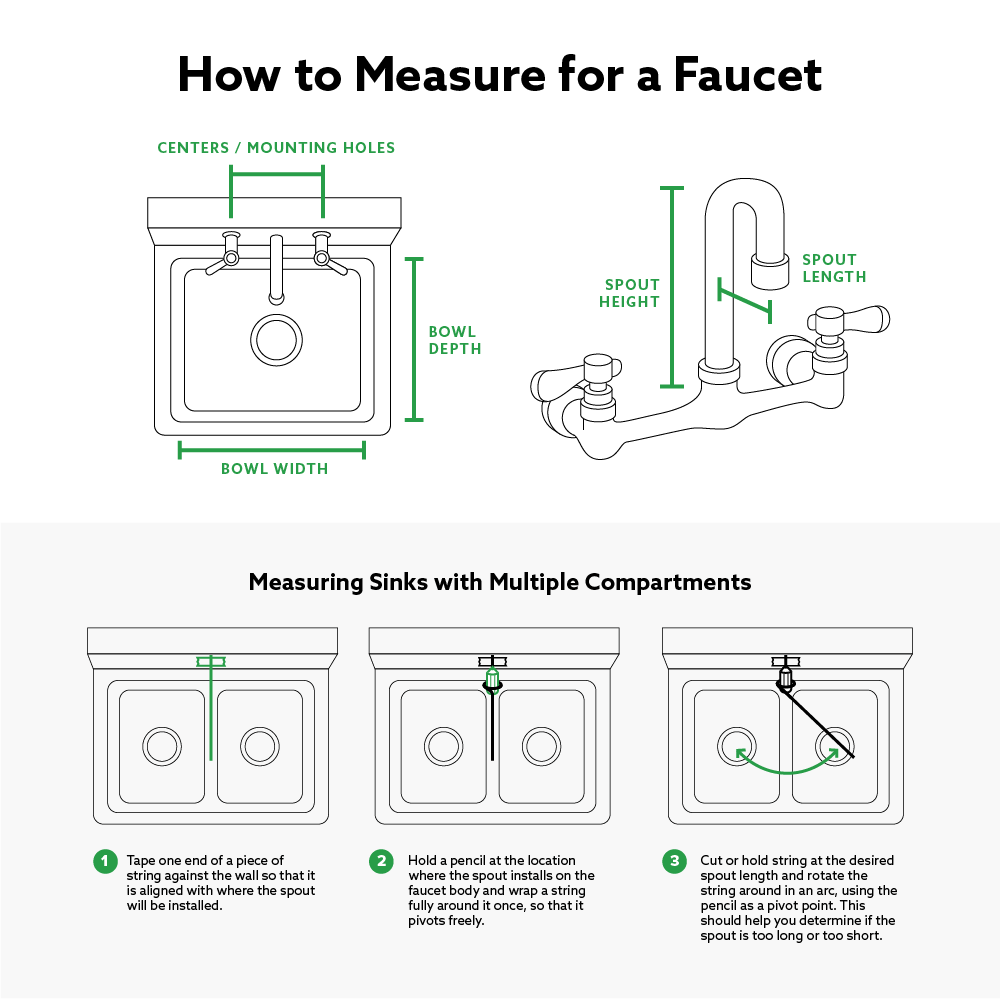
Image Source: lirp.cdn-website.com
Why Accurate Measurements Matter
Before diving into the “how,” let’s briefly touch on the “why.” Incorrect measurements can lead to several problems:
- Fit Issues: A new faucet might not fit the existing holes in your sink or countertop.
- Plumbing Mismatches: The supply lines or valve connections might not align with your current setup.
- Aesthetic Problems: A faucet that’s too tall or too wide might look out of place or not allow for proper clearance.
- Installation Difficulties: The wrong size can make installation difficult, potentially damaging your sink or countertop.
Taking precise measurements upfront prevents these headaches and ensures a smooth replacement process.
Essential Measurements for Your Kitchen Faucet
Several key dimensions will dictate your choice of a replacement faucet. We’ll break them down one by one.
Deciphering Valve Spacing and Mounting Hole Diameter
One of the most critical initial checks is how your current faucet is attached to the sink or countertop. This usually involves looking at the number of holes in your sink and how the faucet components are mounted.
Valve Spacing
This refers to the distance between the mounting holes for the faucet handles and the spout. Faucets come in various configurations:
- Single-hole faucets: These have all components integrated into a single unit, requiring only one mounting hole.
- Widespread faucets: These have separate hot and cold handles and a spout, each mounted in its own hole. The distance between the handles and the spout can vary significantly.
- Centerset faucets: These have the spout and handles mounted on a single base plate, typically spanning 4 or 8 inches between the outer holes.
How to Measure Valve Spacing:
- Identify the Holes: Look at your sink or countertop to see how many holes are used by your current faucet.
- Measure Center-to-Center: If you have multiple holes, measure the distance from the center of one hole to the center of the adjacent hole.
- For widespread faucets, measure from the center of the hot handle hole to the center of the spout hole, and then from the center of the spout hole to the center of the cold handle hole.
- For centerset faucets, measure from the center of the hot handle hole to the center of the cold handle hole.
Most commonly, you’ll encounter 4-inch or 8-inch centerset configurations, or a single hole. Some sinks are designed with multiple pre-drilled holes that might not be utilized by your current faucet. If your sink has more holes than your current faucet uses, you might be able to install a faucet that spans more holes, provided the valve spacing is compatible.
Mounting Hole Diameter
This is the size of the hole(s) in your sink or countertop that the faucet’s base or components pass through.
How to Measure Mounting Hole Diameter:
- Use a Ruler or Tape Measure: Gently measure across the diameter of each hole.
- Standard Sizes: Most kitchen faucet mounting holes are 1.25 inches or 1.5 inches in diameter. However, it’s always best to measure your existing holes to confirm.
If your sink has unused holes and you’re considering a faucet that spans more holes, ensure the diameter of those unused holes is compatible with the new faucet’s mounting hardware.
Fathoming Faucet Spout Height and Spout Reach Measurement
The spout is the part of the faucet that dispenses water. Its height and how far it extends (reach) are crucial for usability and aesthetics.
Faucet Spout Height
This is the distance from the sink deck (the surface of your sink or countertop where the faucet is mounted) to the very top of the faucet spout.
How to Measure Faucet Spout Height:
- Position a Straight Edge: Place a ruler or a straight piece of wood directly on the sink deck, perpendicular to the faucet base.
- Measure Vertically: Measure from the sink deck up to the highest point of the faucet spout.
Why it matters:
- Clearance: A taller faucet might not fit under low-hanging cabinets or shelves above your sink.
- Water Flow: Consider how high you need the spout to be to comfortably wash large pots and pans.
Spout Reach Measurement
This is the horizontal distance from the center of the faucet base to the tip of the spout.
How to Measure Spout Reach:
- Use a Ruler or Tape Measure: Measure from the center of the faucet’s mounting base straight out to the end of the spout.
Why it matters:
- Sink Coverage: A longer spout reach ensures water can reach all areas of your sink basin, especially if you have a double-basin sink.
- Ergonomics: You don’t want to have to lean too far over the sink to get water.
Gauging the Faucet Base Diameter and Sink Cutout Size
These measurements relate to the footprint of your faucet and the openings in your sink.
Faucet Base Diameter
This is the diameter of the widest part of the faucet’s base, which sits on the sink or countertop.
How to Measure Faucet Base Diameter:
- Use a Tape Measure or Caliper: Measure across the widest part of the faucet’s base where it contacts the sink.
Why it matters:
- Coverage: If your current faucet has a wide base, a new faucet with a much smaller base might not cover any old marks or water stains. Some replacement faucets come with deck plates to cover larger areas.
- Aesthetics: A base that is too large might not fit within the existing sink design.
Sink Cutout Size
This refers to the actual opening in your sink or countertop that the faucet passes through. While you often measure the faucet’s mounting holes, it’s also good to be aware of the sink cutout if you’re drilling new holes or need to confirm fit.
How to Measure Sink Cutout Size:
- Measure the Opening: This might require you to remove the old faucet entirely or reach underneath the sink. Measure the diameter of the hole.
Most sinks are designed with standard hole sizes, so this measurement is often more relevant if you have a custom countertop or an older sink.
Assessing Handle Clearance and Compatibility
The handles are operated daily, so their placement and the space around them are important.
Handle Clearance
This refers to the space needed around the faucet handles to operate them comfortably.
How to Assess Handle Clearance:
- Check Existing Space: Swing the handles of your current faucet through their full range of motion.
- Look for Obstructions: Note if the handles hit a backsplash, the wall, or the edge of the sink.
- Measure the Swing Arc: For a new faucet, consider the space required for the handle to turn from off to fully on, both for hot and cold.
Why it matters:
- Usability: You need enough room to easily turn the handles without banging your knuckles against anything.
- Backsplash Impact: If you have a high backsplash, some faucet designs might have handles that are difficult to operate.
Investigating Supply Line Thread Size and Connection Type
This is a crucial step for connecting your new faucet to your home’s water supply.
Supply Line Thread Size
The supply lines connect your faucet to the shut-off valves under your sink. They have standard thread sizes.
How to Measure Supply Line Thread Size:
- Identify the Connection: Look at the end of the supply line that connects to the faucet or the shut-off valve.
- Common Sizes: The most common thread size for kitchen faucet supply lines is 1/2-inch IPS (Iron Pipe Size). However, some older homes or specific faucet models might use 3/8-inch compression fittings.
- Direct Measurement: If you’re unsure, you can use a thread gauge or carefully measure the diameter of the threaded end. It’s often easier to assume 1/2-inch IPS and be prepared to buy adapters if needed.
Hot and Cold Water Connection Type
This refers to how the supply lines connect to the faucet itself. Most modern faucets have integrated flexible supply lines with standard connectors.
How to Identify Hot and Cold Water Connection Type:
- Observe the Faucet: Look at where the supply lines connect to the faucet body.
- Integrated Lines: Most new faucets come with attached supply lines that directly connect to the shut-off valves.
- Connection Fittings: The connectors on these integrated lines are typically 1/2-inch IPS male fittings that screw onto the corresponding female fittings on the shut-off valves.
Important Note: While your faucet might have integrated supply lines, the connection point at the shut-off valve is crucial. Ensure your shut-off valves have the correct size (usually 1/2-inch IPS female) and type of connection for your new faucet’s supply lines. If not, you may need to replace the shut-off valves or use appropriate adapters.
Checking Existing Faucet Dimensions
It’s always wise to have a record of your existing faucet’s overall dimensions to compare with potential replacements.
Comprehensive Measurement Checklist for Existing Faucet
To ensure you have all the necessary information, use this checklist:
- Number of mounting holes: (e.g., 1, 3, 4)
- Valve spacing (center-to-center):
- From spout center to handle center (if applicable)
- From handle center to handle center (if applicable)
- Mounting hole diameter: (Measure across the hole)
- Faucet spout height: (From sink deck to spout tip)
- Spout reach: (From faucet base center to spout tip)
- Faucet base diameter: (Widest point where it meets the sink)
- Overall faucet width: (Including handles)
- Clearance needed for handle swing: (Estimate space required to operate handles)
- Supply line thread size: (Commonly 1/2-inch IPS)
- Supply line connection type: (Usually integrated lines with 1/2-inch IPS male fittings)
It’s helpful to sketch out your sink and faucet, noting these measurements. Taking photos from different angles can also be very useful.
Measuring for Different Faucet Types
The specific measurements you focus on might shift slightly depending on the type of faucet you’re replacing or considering.
Single-Hole Faucets
- Primary Measurement: The diameter of the single mounting hole.
- Spout Height and Reach: Crucial for clearance and sink coverage.
- Base Diameter: Ensure it covers the existing hole adequately, or consider a base plate if it’s smaller.
Centerset Faucets
- Valve Spacing: Typically 4 or 8 inches, this is the most important measurement for compatibility.
- Mounting Hole Diameter: Ensure the centerset base fits the existing holes.
- Spout Height and Reach: For practical use.
Widespread Faucets
- Individual Valve Spacing: Measure from the center of each component hole to the next. This is highly variable.
- Mounting Hole Diameters: Each component (spout, handles) will have its own hole.
- Spout Height and Reach: As with other types, important for functionality.
What If Your Sink Has Unused Holes?
Many sinks come pre-drilled with more holes than a single-hole or centerset faucet might use. This is a common scenario.
- Deck Plates: If you’re moving from a 3-hole faucet to a single-hole faucet, most single-handle faucets come with an optional deck plate (also called a escutcheon plate). This plate covers the extra holes, providing a clean look. Measure the distance between the holes your current faucet uses to ensure the deck plate will fit your sink’s configuration.
- Widespread Compatibility: If your sink has 3 or 4 holes spread out, you might be able to install a widespread faucet. You’ll need to measure the spacing between these holes to find a widespread faucet with compatible dimensions.
Tools You Might Need
- Tape Measure: For most linear measurements.
- Ruler: For smaller, more precise measurements, especially hole diameters.
- Pliers or Adjustable Wrench: To gently loosen and examine supply line connections (turn off water first!).
- Soft Cloth: To protect the sink finish while measuring.
- Pen and Paper or Smartphone: To record your measurements.
- Flashlight: To see clearly under the sink.
Final Checks Before Purchasing
Once you have all your measurements, cross-reference them with the specifications of the new faucet you’re considering.
- Does the valve spacing match?
- Will the spout height fit under your cabinets?
- Is the spout reach adequate for your sink?
- Does the base diameter cover your existing mounting holes, or do you need a deck plate?
- Are the supply line connections compatible with your shut-off valves?
By meticulously measuring your existing kitchen faucet and sink setup, you’ll be well-equipped to choose and install a replacement that fits perfectly and functions beautifully.
Frequently Asked Questions (FAQ)
Q1: What if my faucet has a sprayer hose connection?
A1: Most modern faucets have integrated sprayers, meaning the hose is part of the faucet assembly. You don’t typically measure the sprayer hose connection itself, but ensure the new faucet comes with the type of sprayer you desire (side sprayer, pull-down, pull-out). The connections for the sprayer hose are usually standard.
Q2: My sink has unused holes. Can I install a faucet with a different number of holes?
A2: Yes, often you can. If you’re downsizing from more holes to fewer (e.g., 3-hole to single-hole), look for a faucet with an accompanying deck plate or escutcheon to cover the unused holes. If you’re moving from fewer holes to more (e.g., single-hole to widespread), you’ll need to ensure your sink has the necessary holes and that the spacing is compatible with the widespread faucet.
Q3: What does “centerset” mean for a faucet?
A3: A centerset faucet has the spout and handles mounted on a single base plate. The common configurations are 4-inch or 8-inch centerset, referring to the distance between the outer mounting holes for the handles.
Q4: Do I need to turn off the water before measuring?
A4: You don’t need to turn off the water just for measuring the faucet itself. However, if you plan to disconnect any supply lines to get a closer look at the threads, you must turn off the water using the shut-off valves under the sink first.
Q5: What’s the most common measurement mistake people make?
A5: The most common mistake is not measuring the valve spacing or spout reach accurately. This leads to compatibility issues with the sink or usability problems, like not being able to fit pots under the spout.
Q6: My shut-off valves are old. Should I replace them too?
A6: If your shut-off valves are old, corroded, or stiff, it’s highly recommended to replace them while you’re replacing the faucet. This prevents potential leaks and ensures you have reliable shut-off points for future maintenance. Ensure the new shut-off valves have the correct thread size (usually 1/2-inch IPS) for your faucet’s supply lines.